
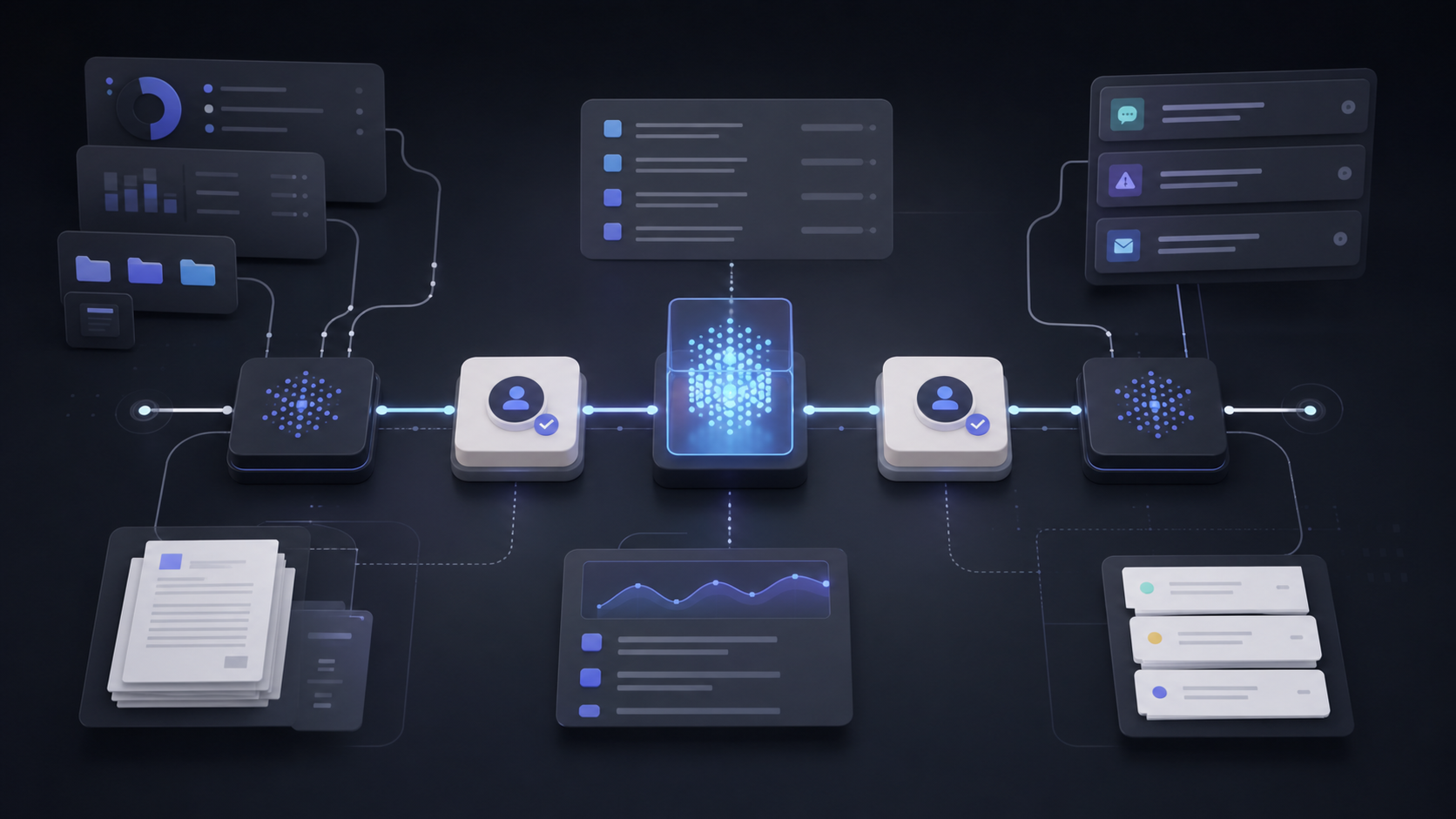
Most AI automation projects do not fail because the model is incapable. They fail because the system is not designed around the way work actually moves through the business.
A support team does not just need a classifier. It needs intake rules, escalation paths, audit trails, confidence thresholds, and a way for people to correct the system when it gets something wrong. A finance team does not just need invoice extraction. It needs validation, exception handling, approvals, and clean handoff into accounting tools.
That is why useful AI automation starts with operational context. The question is not “Which model should we use?” The better question is “Where does work slow down, what decisions repeat, and what would make the next step easier for the person responsible?”
The model is rarely the product. The product is the workflow around it.
Start with the workflow, not the model
Before choosing tools, map the workflow in plain terms: what comes in, what needs to be understood, who acts on it, which systems need to be updated, and where exceptions happen. This gives the automation a job description.
For example, an inbound lead workflow might include reading a form submission, identifying company size, checking whether the request matches your services, enriching the company profile, scoring urgency, and routing it to the right owner. AI may help with several of those steps, but the value comes from connecting them into a reliable flow.
When the workflow is clear, model choice becomes easier. You can decide whether you need classification, extraction, summarization, routing, generation, search, or a combination of these patterns.
Keep humans in the right places
Good automation does not remove people from every decision. It removes the repetitive parts that prevent people from making better decisions. The system should know when to act, when to suggest, and when to stop.
A practical design usually includes confidence thresholds. If the system is confident, it can move the work forward. If confidence is low, it can prepare the context and ask for review. If the case is sensitive, high-value, or unusual, it should route to a person immediately.
This is how teams build trust. People are more likely to use automation when they can see why something happened and when they know they can override it.
Integrate where work already happens
AI automation is weakest when it lives as a separate tool that people have to remember to open. It is strongest when it appears inside the systems the team already uses: CRM, help desk, Slack, Google Chat, email, dashboards, internal admin panels, or custom software.
The output should be operational, not decorative. A summary should be attached to the ticket. A lead score should update the CRM. A document extraction should create a review task. A customer message should preserve source context and next actions.
The fewer manual handoffs the team has to perform after the AI step, the more useful the automation becomes.
Measure business outcomes
Accuracy matters, but it is not the only metric. A system can be technically accurate and still fail to create value if it does not reduce cycle time, rework, backlog, or manual effort.
Track metrics that connect to the workflow: time to first response, number of tickets auto-routed, percentage of documents needing correction, lead response time, exception rate, hours saved, and user override patterns.
These numbers show whether the automation is improving the business process, not just whether the model performs well in isolation.
Treat it like a product
Real AI automation needs monitoring and iteration. Inputs change, customer behavior changes, internal policies change, and edge cases appear after launch. The system should be built with enough visibility to improve over time.
That means logging decisions, collecting corrections, reviewing failures, and refining prompts, retrieval sources, rules, and integrations. The first version should be useful, but it should also create the feedback loop needed for the second version to be better.
The businesses that get durable value from AI automation do not treat it as a one-time experiment. They treat it as part of their operating system.
Amsten Team
Written from the field by the Amsten team.